
Responsible AI Navigator
Your gateway to navigating AI with integrity - supporting responsible decision-making for sustainable businesses worldwide.

Bridging the Gap Between Innovation and Integrity
The pressure to adopt AI is real — and so is the responsibility to develop and deploy it with integrity. Navigating that tension is one of the defining challenges for business today: how to move at the pace of innovation while upholding the values and standards that build lasting trust.
"Innovation without responsibility is a risk no business can afford. At the UN Global Compact, we emphasize that AI must be guided by a steadfast commitment to social responsibility to ensure it remains a durable driver of long-term value."
Sanda Ojambo, ASG of the UN Global Compact

“Human rights provide an inspiring vision of AI that can make our world safer and more peaceful, and develop it through human creativity, imagination and purpose. In short, human rights provide a governance model that is long-term and inter-generational, that links our past with our present and our future."

Driving Change
In line with the UN Global Compact Strategy, the Responsible AI Navigator is a curated resource hub for businesses ready to move from intention to implementation. Explore practical guidance for developing, procuring and deploying AI in ways that respect people, align with international standards, and support responsible business conduct across the entire AI value chain. Access trusted tools, frameworks, and insights on AI governance, human rights due diligence, and responsible implementation — helping your organisation build and scale AI with confidence and trust.

Popular On-Demand Courses
Deepen your knowledge through a curated collection of free e-learning courses designed to build practical skills and support responsible business action.

AI & Human Rights: Practical Strategies for Responsible Adoption
Expand your understanding of responsible AI approaches that support both innovation and ethical business practices.

AI and Human Rights 101
Learn more about the UN Guiding Principles (UNGPs) and how they apply to technology development and deployment.

Responsible Investing into AI
Explore how applying human rights due diligence measures can benefit investors materially while contributing to the protection of human rights.

How will Gen AI Change Sustainable Business?
Discover how Gen AI can accelerate sustainability while addressing critical risks to ensure it benefits all stakeholders.
Upcoming Live Sessions
Join our next live webinar to hear directly from experts, ask questions and learn more about what responsible AI adoption can look like. Register now to stay up-to-date on session information.

Recommended Resources
Explore a curated collection of tools, guides and reports that inspire practical action and help businesses and practitioners strengthen human rights due diligence across operations and supply chains.
UN Global Compact and Expert Partner Resources

Leveraging Tech Solutions for Human Rights Due Dilligence
This Human Rights Think Lab report, distils practical lessons from 25 leading companies and organisations on how technology can strengthen human rights due diligence in supply chains, emphasizing human judgment, risk mitigation and ensuring technology complements, rather than replaces, core due diligence practices.

Gen AI for the Global Goals
Developed by the UN Global Compact and Accenture, this report guides business leaders on deploying generative AI responsibly while creating business value, with strategies, case studies and tools to harness Gen AI in support of the Sustainable Development Goals.

Business and Human Rights Navigator
The Business & Human Rights Navigator is an online platform that helps companies understand and manage human rights impacts across operations and supply chains, providing UNGP-aligned guidance, due diligence recommendations and examples, including on digital and emerging technologies.
The AI Company Data Initiative
Published in March 2026 by the Thomson Reuters Foundation, in collaboration with UNESCO, this report reveals a significant gap between AI adoption and governance: nearly 90% of companies surveyed have not committed to any named AI governance framework, only 13% have a policy to ensure human oversight of AI systems, and just 5% conduct ethical impact assessments.
OHCHR B-Tech Guidance
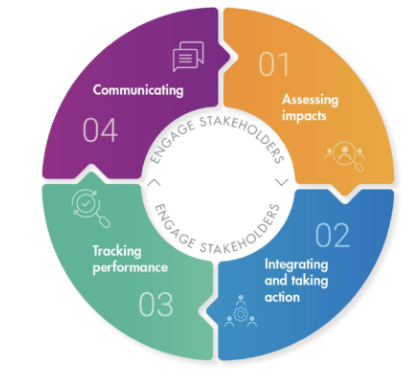
The OHCHR B-Tech Project provides authoritative guidance on how to apply the UN Guiding Principles on Business and Human Rights (UNGPs) in the technology sector, including in relation to AI and other digital technologies. It is particularly helpful for companies that want to embed human rights into technology governance, product design, risk management and stakeholder engagement in a way that is grounded in internationally recognized standards.

Due Diligence Guidance for Responsible AI
This OECD guidance provides practical support for enterprises applying responsible business conduct standards and the OECD AI Principles to AI-related activities. It is especially useful for companies looking for a structured due diligence approach to identify, prevent, mitigate and account for adverse impacts linked to AI systems across their operations and value chains.

Global Digital Compact
Adopted at the UN Summit of the Future in September 2024, the Global Digital Compact (GDC) is the first comprehensive multilateral framework for digital cooperation and AI governance. The GDC explicitly calls on digital technology companies, developers and social media platforms to respect human rights online, be accountable for and take measures to mitigate and prevent abuses, and to provide access to effective remedy - in line with UNGPs.
UN AI Resource Hub
The UN AI Resource Hub, supported by ITU and other UN agencies, is a centralized gateway to UN policies, tools and initiatives on AI, enabling businesses to navigate AI governance expectations and technical resources across the UN system.
Share. Connect. Advance.
Knowledge grows through collective action. Share resources, submit content or tell us what your business needs — and help shape the conversation on responsible AI in business.
