
How Siam Piwat Transformed Underused Space into a Sustainable Retail Model Reaching 4.2 Million Visitors
Start Reading

1. Company at a Glance
This case study shows how Siam Piwat transformed existing retail space within Siam Paragon shopping mall into NEXTOPIA, a 15,000-square- metre retail and experience destination combining shops and food-and-beverage operators with sustainability-focused infrastructure, technologies, workshops, exhibitions and community activities. Launched in November 2025, NEXTOPIA serves as a live prototype for testing how sustainability can be integrated into a commercial environment and the customer experience.
Real Estate / Retail
Industry
1959
Founded
Thailand
Headquarters
2,400+
Number of Employees
2. The Challenge
Turning sustainability into a retail proposition customers would engage with
Siam Piwat develops and operates large-scale retail and lifestyle destinations, including Siam Paragon shopping center. Across its destinations, the company receives more than 100 million visitors annually. This scale gives it significant influence over everyday consumer decisions, from shopping and dining to leisure and entertainment.
The company identified a gap between awareness of sustainability issues and changes in everyday behavior. Customer and employee input indicated that sustainability messaging could feel abstract, restrictive or associated with sacrifice, while early customer engagement also highlighted skepticism toward corporate sustainability claims. For Siam Piwat, the challenge was therefore both a sustainability and a business question: how could sustainability become part of an attractive retail experience while maintaining the commercial relevance expected from a major retail destination?
3. The Action
Building and testing a sustainability-driven retail prototype
TRANSLATE SUSTAINABILITY INTO DESIGN REQUIREMENTS
To address customer skepticism and disengagement with traditional corporate messaging, Siam Piwat replaced conventional feasibility studies with an interdisciplinary discovery process bringing together designers, retail operators, sustainability specialists, and customer experience teams.
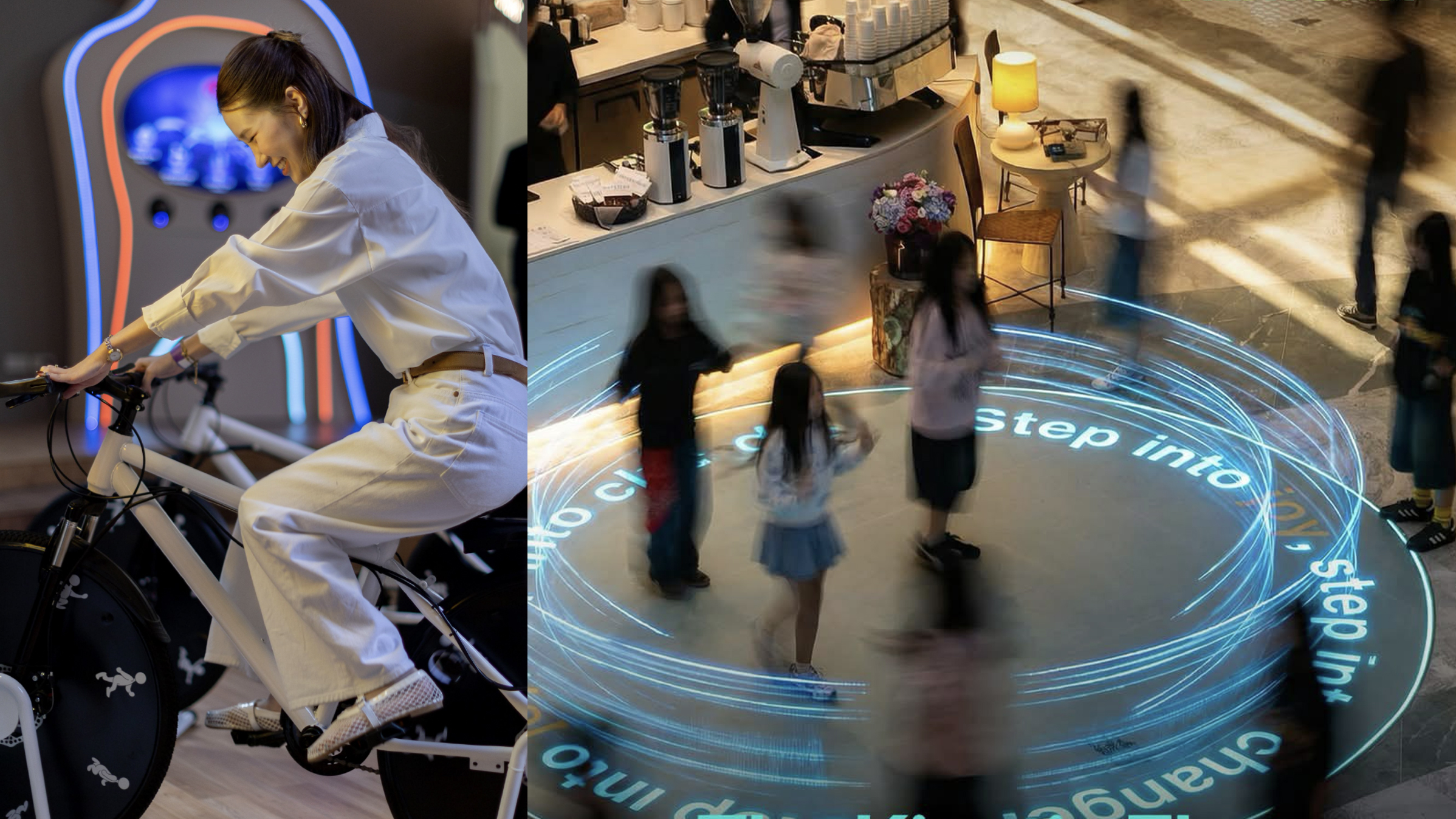
This team translated the company’s sustainability ambitions into concrete requirements for both the retail space and the visitor experience. The concept combined resource-efficient infrastructure and sustainable materials with interactive features that allow visitors to experience sustainability in practice, including energy-generating installations, a vertical farm and tools showing the environmental impact of the space.
Direct feedback from frontline staff and consumers led the team to mandate verified material provenance, clear lifecycle data, and tangible solutions across all installations, ensuring the space directly tackled concerns about greenwashing while driving active visitor participation.
CURATE A PARTNER ECOSYSTEM AROUND THE CONCEPT
With NEXTOPIA conceived as a live retail and experience environment where sustainability is embedded into both commercial activity and visitor engagement, Siam Piwat mapped potential participants across four areas: innovation and technology; retail and consumer goods; communities and social enterprises; and experiential content.
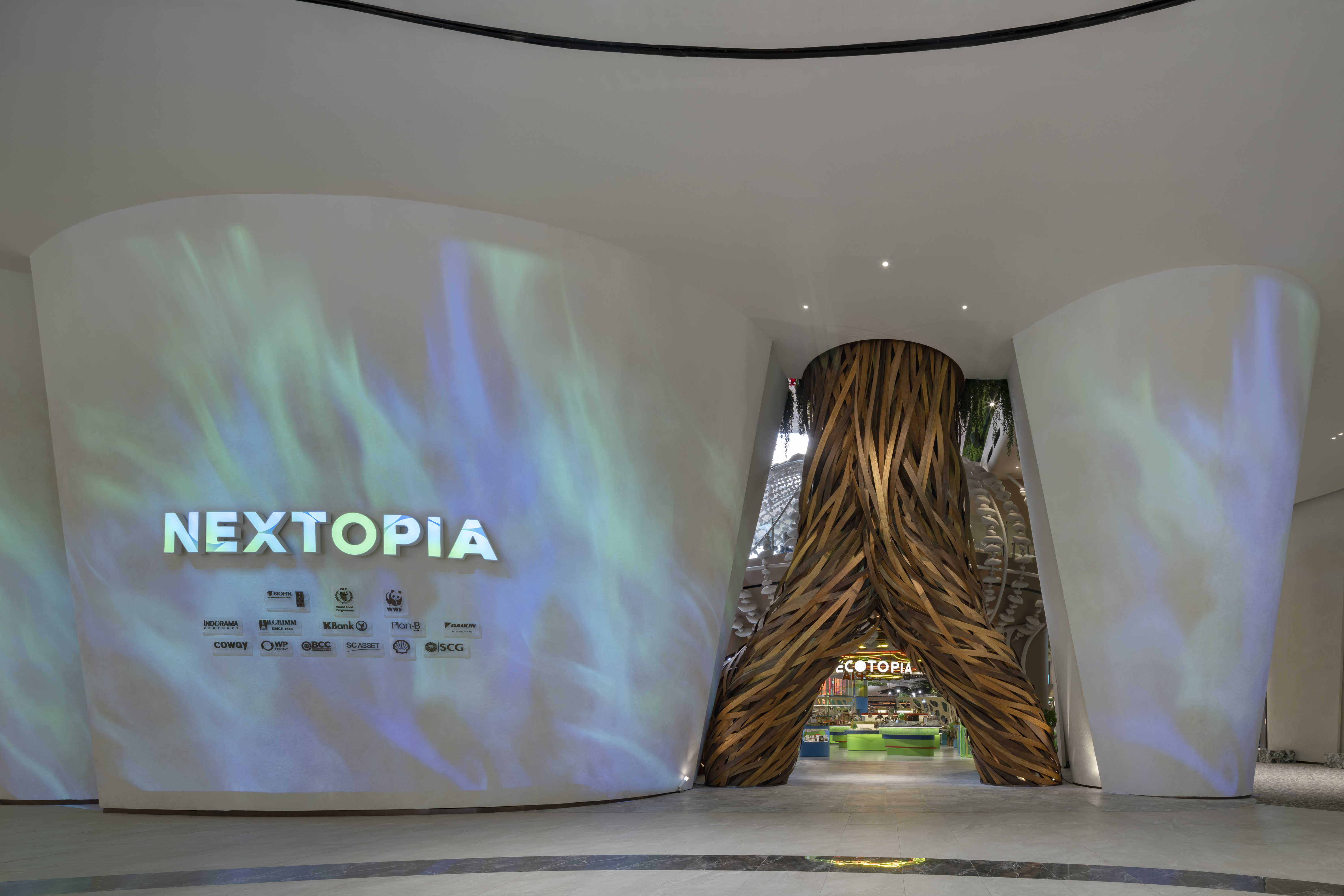
The process brought more than 50 founding partners, more than 40 retailers and food-and-beverage operators, over 300 SMEs and social enterprises, and more than 30 community groups into the initiative. The SMEs and social enterprises are primarily showcased through ECOTOPIA, an eco-lifestyle retail platform within NEXTOPIA offering more than 110,000 sustainable products and providing smaller businesses with access to customers within Siam Paragon.
Community partners, including Bangkok Climate Action Week (BKKCAW), Climate Finance Network Thailand (CFNT), Big Trees and KongGreenGreen, contribute sustainability-focused activities and networks intended to attract participants and build an active community around the space.
Partner responsibilities were then incorporated into the implementation roadmap, including the use of space, delivery of content and participation in operations.
BUILD SUSTAINABILITY INTO THE RETAIL SPACE
Siam Piwat retrofitted existing retail space on the 5th and 5A floors of Siam Paragon to launch NEXTOPIA, transforming an underutilized venue that previously operated as a foyer for Paragon Hall into an operating retail and experience space. The space incorporates renewable energy systems, energy-efficient cooling, water-management solutions, air-quality technologies, and sustainable or reused materials in its construction and interior design.
The environmental performance and indoor quality of the space are validated by international third-party standards, including EDGE Advanced certification, Fitwel 2-star certification and the Best in Building Health Award 2026.
EMBED SUSTAINABILITY INTO TENANT OPERATIONS AND SUPPLIER CAPABILITIES
Sustainability requirements extend beyond physical assets directly into tenant operations. Rather than restricting entry to already certified green brands, NEXTOPIA functions as an inclusive operational sandbox where participating retailers, food-and-beverage operators, SMEs and suppliers raise their baseline practices.
ECOTOPIA extends this approach to participating SMEs and social enterprises, giving them a retail environment in which to apply sustainability requirements while reaching mainstream consumers.
All participating businesses must comply with mandatory sustainability rules, specifically adhering to strict waste- management protocols designed to achieve zero waste to landfill through mandatory source separation. Through this sandbox approach, Siam Piwat provides ongoing operational guidance to conventional brands, enabling them to test sustainable practices in situ before scaling learnings to their wider store networks.
Furthermore, curated activations demonstrate practical value-chain solutions; for instance, an August 2026 initiative with the Gem and Jewelry Institute of Thailand (GIT) provided participating businesses with practical tools for responsible raw-material sourcing and operational traceability.
LAUNCH NEXTOPIA AS A LIVE PILOT
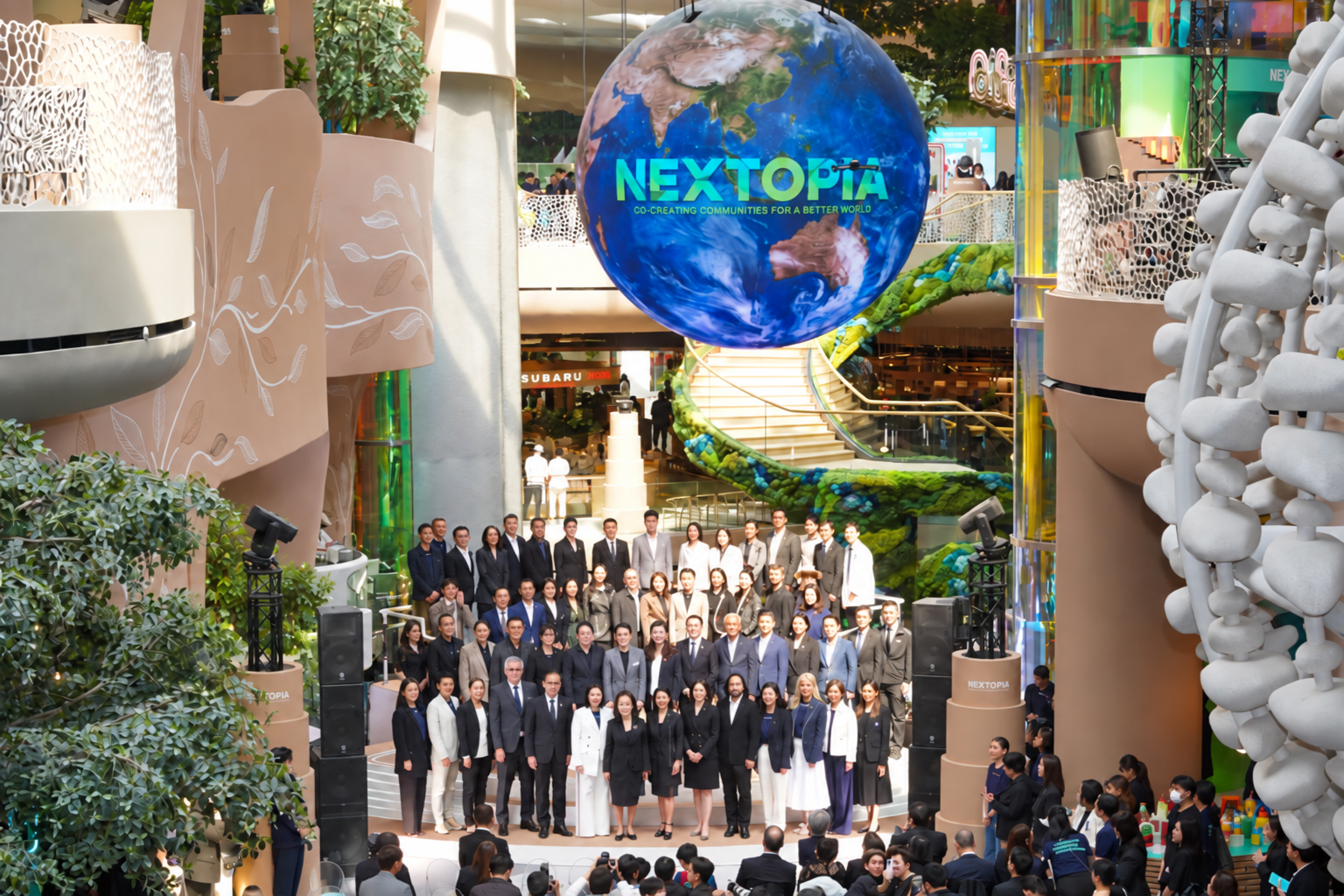
Siam Piwat launched NEXTOPIA in November 2025 as an operating retail environment. Initial visitor groups included existing Siam Paragon customers, community partners and employee volunteers.
From the first weeks of operation, teams observed how people moved through the space, collected feedback and tested whether installations and content were understood. These observations were used to adjust wayfinding, staff training, visitor flows and the design of individual experiences.
The company adopted what it calls a “Sustainability in the Making” approach: installations, partnerships and experiences can be modified as new information becomes available. Modular installations and flexible partnership arrangements were designed to support these ongoing adjustments.
MEASURE SUSTAINABILITY AND COMMERCIAL PERFORMANCE TOGETHER
NEXTOPIA required a broader performance framework than Siam Piwat typically used for conventional retail. Traditional indicators such as footfall, conversion and revenue per square meter could capture commercial performance but not outcomes such as customer engagement, learning or behavioral intentions.
Siam Piwat worked with academic advisors and sustainability specialists to develop additional indicators. These include dwell time, repeat visitation, interaction completion, visitor sentiment, self-reported behavioral intentions and partner-led conversion, alongside environmental indicators covering energy, water, waste and greenhouse gas emissions.
Visitor comments and operational data are collected daily and reviewed weekly. Underperforming content, partner activations and elements of the visitor journey can then be modified or replaced.
NEXT STEPS
Siam Piwat plans to use the NEXTOPIA experience to inform sustainability-driven development across other destinations in its portfolio.
The company is also developing a more structured impact roadmap covering energy, water, materials and user experience, with defined KPIs intended to strengthen measurement of environmental performance and customer and partner engagement.
4. Overcoming Barriers
Changing conventional retail behavior
One of the first operational difficulties was that visitors initially approached NEXTOPIA as they would a conventional retail space: looking for clear product displays and direct purchase pathways. This reduced engagement with some of the interactive elements and affected indicators such as dwell time and repeat visitation.
Siam Piwat responded by introducing guided tours led by NEXTOPIA Ambassadors, redesigning entry signage, positioning trained engagement guides throughout the space and introducing simpler activities as entry points to deeper participation. Staff training was adjusted to emphasize facilitation rather than sales, while content was increasingly connected to familiar topics such as food, fashion and household habits.
Coordinating hundreds of participants
Managing more than 50 founding partners, over 40 retailers, more than 300 SMEs and more than 30 community groups created operational complexity.
Siam Piwat assigned relationship managers as single points of contact for different stakeholder groups and established regular coordination forums focused on resolving operational issues and sharing learning.
5. Impacts & Results
Environmental performance
A 47% reduction in energy consumption;
A 34% reduction in water consumption through water- saving sanitary equipment
100% Zero Waste to Landfill since opening; and
Operation using 100% renewable energy.
A 59% reduction in carbon emissions associated with construction and decorative materials, supported by the use of durable, reused, recycled and natural materials;
NEXTOPIA also received EDGE Advanced certification for resource efficiency and a 2-Star Fitwel rating for health and well-being-focused design, alongside the Fitwel Best in Building Health Award 2026 and the FIABCI-Thai PRIX D’EXCELLENCE AWARD (Sustainable Development Category).
Customer and community engagement
More than 100 sustainability-related events involving more than 120,000 participants, including workshops, exhibitions and educational activities.
A total of approximately 4.2 million visitors (since its launch in November 2025), successfully drawing customer traffic to upper mall levels (Floors 5 and 5A) and leveraging Siam Piwat’s annual reach of over 100 million visitors across its destinations.
Official recognition as a UN Global Compact Network Thailand (GCNT) Learning Center and presentation as a case study at The Economist’s Sustainability Week 2026.
Business relevance
Monetization of underutilized real estate, transforming the Paragon Hall foyer into an active lifestyle and commercial destination that generates revenue from day one.
The initiative has also begun to influence practices beyond the NEXTOPIA space, including procurement policies, staff training and customer-engagement approaches across Siam Piwat.
6. Key Lessons Learned
Define the customer experience before selecting sustainability solutions
Establishing clear design principles first helped Siam Piwat evaluate technologies, partners and content according to how they contributed to the customer experience and everyday decision-making.
Build impact measurement into the project from the beginning
Developing some behavioral and community indicators after implementation had already started made it more difficult to establish baselines. For similar initiatives, customer-behavior measures, commercial indicators and sustainability KPIs should be defined together before launch, even if the framework is subsequently refined.
In retail, participation must be designed around familiar behavior
Early visitors did not automatically change the way they behaved simply because they entered a sustainability-focused space. Guided orientation, simpler entry points and content linked to food, fashion and household decisions were needed to make participation more intuitive. The experience showed that changing the sustainability message is not enough; the customer journey itself also has to change.

"Siam piwat creates the Nextopia model to prove that ESG is not a costly obligation, but a profitable and sustainable way forward. By bringing together organizations, communities, technology and creativity with a shared purpose, we can create better businesses, stronger communities and a better world for everyone.”
Chadatip Chutrakul, CEO, Siam Piwat Company Limited
7. Company Commitment
Siam Piwat has been a committed participant in several UN Global Compact initiatives since 2025
8. Recommended Resources
Recommended UN Global Compact Resources



Download Case Study
Disclaimer: This case example is intended strictly for learning purposes and does not constitute an endorsement of the individual companies by the UN Global Compact.